Spark Notes
What Is the Va 529 Tuition track Portfolio?
Have you heard about the Virginia 529 Tuition Track portfolio and are wondering whether it makes sense for your family? Or perhaps you are looking for an alternative to the Virginia 529 Prepaid tuition program. In this article we’ll explain what the new Tuition Track portfolio is, how it works, and who may want to use it.
The new Tuition Track portfolio sits inside the Virginia Invest 529 program as a new investment option. It’s designed, in some ways, to replace the old Virginia 529 Prepaid tuition program and it may be a good option for savers who have concerns about putting tuition money in the stock market, but know that putting college savings into cash and bonds or cash alone will likely not earn enough return to keep up with college cost inflation.
The Tuition Track portfolio is designed to keep up with the inflation rate of the average Virginia public school college tuition; which has run on average about 5% a year in Virginia, though more recently it’s been significantly lower. You can use it for public or private schools, in-state or out-of-state, and for qualified higher education expenses beyond tuition costs alone.
A few quick details from VA 529:
- To purchase the Tuition Track portfolio either you or the account beneficiary must be a Virginia resident.
- A beneficiary cannot own more than 1,000 Tuition Track portfolio units at a time.
- The Tuition Track portfolio units must be held for 3 years before they can be used.
- You can buy Tuition Track portfolio units up until June 30th of the year of “expected usage” (i.e. generally the year your student graduates from high school). If your student is already enrolled in college they are not eligible for this program.
- There are no asset based fees associated with this investment option.
- Tuition Track is designed for post-secondary education and is not a great option for families who want to use VA 529 money for K-12 private tuition.
The Tuition Track portfolio takes the average price of Virginia public colleges and universities, and divides it into 100 units. College savers can buy units for a set price calculated every year. For 2021 the current average tuition cost is $13,636 according to the Virginia 529 website. We would then take the average tuition of $13,636 and divide it by 100 to get the cost of a unit. In 2021 units are being sold for $136.36.
#Thanks William & Mary for increasing the price by blowing up the average.
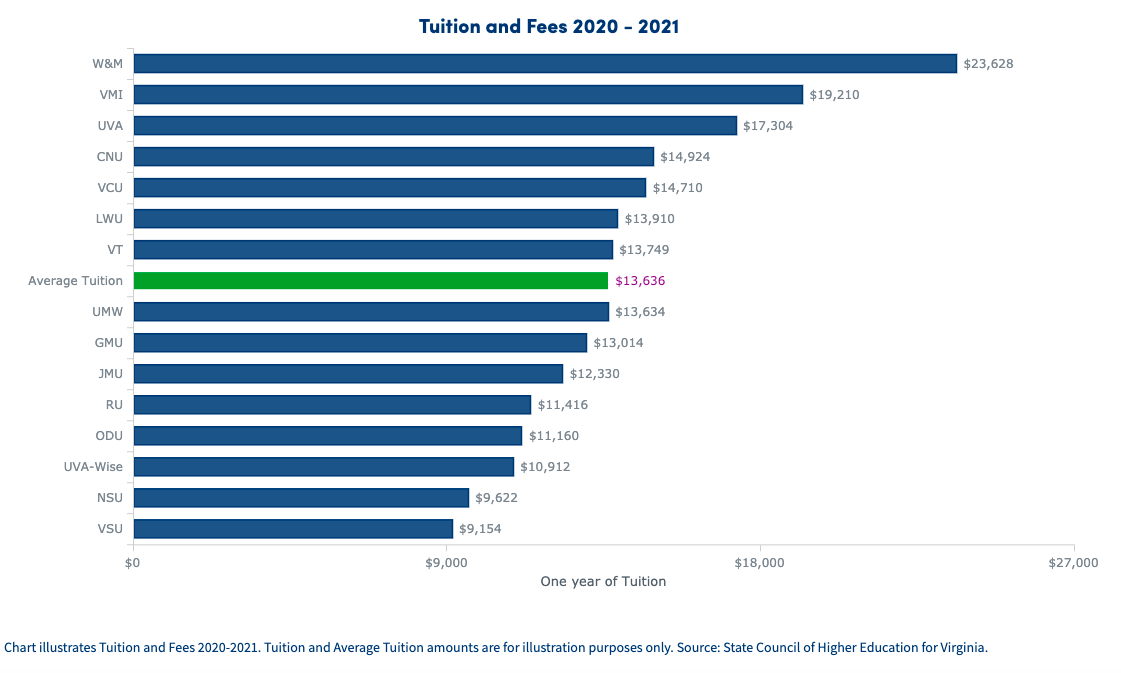
Source: https://www.virginia529.com/invest/tuition-track/
Once you purchase 100 units, you have purchased one year’s worth of tuition at a Virginia public in-state college or university. Most families will not be able to afford purchasing 100 units (currently $13,636) in a single year.
This means you might buy 25 units in 2021 for $3,409 (25 x $136.136).
Then in 2022 you buy another 25 units, but this time the price has increased by 5% to reflect the rising cost of tuition, so it costs you $143.18 per unit or $3,579.
In 2023 another 5% inflation rate increase means 25 units costs $150.34/unit or $3,758.
In 2024 you pay for another 25 units with a 5% inflation increase and at $157.86 a unit it costs you $3,946.
All in, over 4 years you paid $14,692 for one year’s worth of tuition at the average Virginia public school.
What happens if your child’s school is more expensive than average?
If you’re targeting UVA, William & Mary, or another school with above average tuition, this is not an arbitrage opportunity. Unfortunately, you can’t pay for a year of tuition at the average price and then turn around and use it at an above average cost school. Instead, what happens is VA 529 will use the average calculated value of a year of tuition and deduct it from the college your student is attending, then you will have to pay the difference from cash flow or savings.
For example, let’s say you purchase 1 year of tuition (100 units) via the Tuition Track portfolio option. Three years later, the average cost of tuition at a Virginia in-state public school is $15,000. This means your Tuition Track portfolio is worth the equivalent of $15,000 worth of tuition. If your student decides to attend a school where tuition costs $25,000 a year you will have the $15,000 tuition track portfolio to pay for part of the cost and you will have to pay the $10,000 difference from cash flow or other savings.
If your student’s school tuition costs are below average, you will use fewer units to pay for tuition. In other words, you may not have to spend $13,636 in 2021 to get a year’s worth of tuition at Radford. So there is no penalty for attending a lower cost school.
When does the Tuition Track make sense?
To start, if your child is beyond their “expected usage date” (i.e. June 30th of the year they graduate from high school) you can’t purchase Tuition Track portfolio units. If you are within 3 years of using the Tuition Track portfolio, you probably should not purchase tuition track portfolio units because if you use the units within 3 years of purchase you will get your contribution back plus interest.
Beyond those caveats, I see a few possible scenarios where the Tuition Track portfolio is attractive (though I’m sure there are more, leave your thoughts in the comments) :
- You are relatively close to your child entering college (less than 7 years but more than 3 years) and you are concerned about your college savings account losing value in the stock market.
- You want to create a custom portfolio where you invest the equity portion of your 529 allocation in the broad stock market-based options, and instead of investing in bonds you decide to use the tuition track portfolio as the bond portion of your portfolio.
Scenario 2 is intriguing in a low yield environment (i.e. where bond prices are high and interest rates are low) – bonds may generally protect you from losing a lot of money but not create much return. There is, of course, a place for bonds in a diversified portfolio over the long-term; bonds have historically helped balance out more volatile stock investments during market downturns and provided some level of return. At the same time, if we have access to an inflation protected investment option that protects value on the downside and rises with our expected cost on the upside – it’s pretty attractive.
The Tuition Track portfolio may be more attractive than other investment options tied to inflation (for example, Treasury Inflation Protected securities) because the inflation rate associated with college costs has significantly outpaced general inflation over the last few decades.
Tuition Track Risks
If college costs crater or rise at a very low rate, then a college saver may be better off investing in a more aggressive portfolio. In other words, while your Tuition Track portfolio is principal protected (you will be able to take back out what you put in) it will not grow if tuition costs don’t rise. For example, while the longer-term tuition inflation rate has been close to 5%, over the last two years in Virginia the tuition inflation rate has been under 2%.
Or it’s possible that if college tuition inflation is less than general inflation moving forward, you may be better off in an investment that is tied to general inflation or even plain bonds over the longer term.
Another risk is simply that you don’t buy enough Tuition Track portfolio units because your child ends up attending a Virginia public school with a higher than average tuition rate.
With these risks in mind, we would generally view the Tuition Track as part of a broader 529 portfolio. Talk to your financial advisor before making any changes.
Comparing the Tuition Track & the Old Prepaid Tuition Program
Before we dive in, it’s important to note that the Virginia Prepaid plan is not open to new participants. The plan permanently closed in May of 2019, but existing contracts are still in force. This is really important – if you already have a Virginia Prepaid tuition plan you can still use your prepaid contract. The notes below are meant to compare the two, as they are similar and many are more familiar with the now-defunct prepaid tuition.
The biggest benefit of the Prepaid plan vs. Tuition Track is that one year of pre-paid can be used to cover ANY Virginia public school in full. As mentioned earlier, this means that with an old prepaid tuition program you wouldn’t be on the hook for the difference between the school of your student’s choice and the state average, whereas with Tuition Track you would.
A secondary benefit is that you could lock in the price of the full year’s tuition with Prepaid, and then chip away at that cost over a couple years with a payment plan. With the new Tuition Track option, there is no option to lock in a year’s worth of tuition, you simply buy units at that year’s average rate, which will very likely increase year over year.
On the other hand, there were drawbacks to Prepaid that don’t exist in Tuition Track. First, Prepaid really hemmed you into attending a Virginia school. If your child ended up attending an out of state school, you could essentially get your money back, but the “return” on your contract was at cash investment rates (translation: very likely lower than inflation). Given how quickly college tuition costs have been rising, you functionally ended up in a hole if your child didn’t attend a Virginia public school.
Second problem, Prepaid was less flexible in which of your future students could take advantage of the money. With most Virginia 529 plans, including the Tuition Track portfolio, you can roll the account to other family members. However, with the Virginia Prepaid tuition program there were some constraints on who was eligible to receive the rollover. Having multiple children, at least one of which would likely attend a state school, made this less of an issue of course – especially since Virginia has so many terrific public schools.
Third problem, Prepaid was really expensive. Virginia 529 did a good job trying to make it affordable by breaking it up into units and allowing payment plans. Still, it was pricey.
As a financial planning firm, we are intrigued by the new Tuition Track portfolio and think for many planning for college tuition it could be a smart element of a college planning strategy. What are your thoughts? What questions do you have? You can leave them in the comments or email me directly lauren (at) spark financial advisors . com
Interested in working with Spark Financial Advisors? Book a call to learn more!


I just bought 420 units using my sons existing 529. He is in seventh grade. So essentially 5.4 years before he starts college. For me it took away Markey risk as the Dow has been tanking and since he is basically five years out, his 529 was mostly in fixed assets with just a little in equities. It also gave me peace of mind that I got that jobs done. I then opened a new 529 to sock away for housing, food and fees. Because he is closer to college, we are in our peak earning hears and can sock away a lot in the next 5.4 years to save the rest. Could I have earned a few thousand dollars more in his traditional529 versus the tuition tracker? Possibly but I rest easy knowing his tuition is mostly paid.